Flooded Basement? What to Do First, in 7 Steps
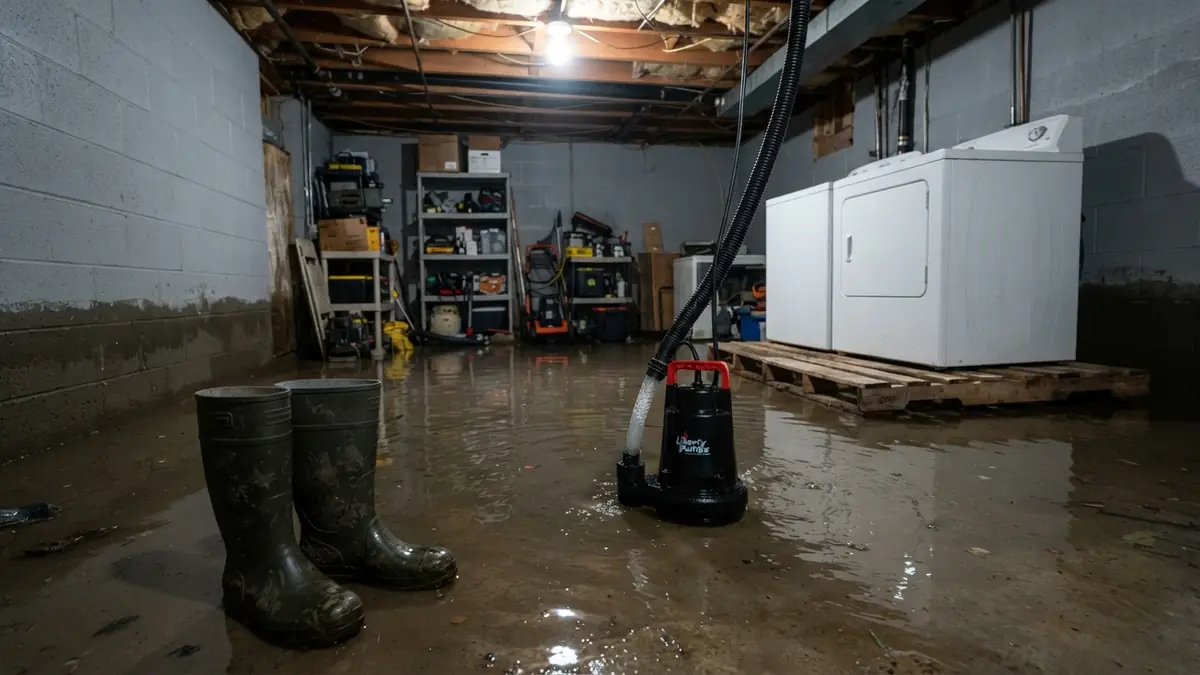
Walking down the stairs into water is a panic moment, and the order you do things in matters more than how fast you move. Safety comes first, then stopping the water, then getting it out.
Most flooded basements trace back to a sump pump that quit or lost power during heavy rain, storm water pushing up through a floor drain, or a washer or water heater letting go. These seven steps work for all of them.
1. Cut the power before you step in
Turn off the breakers that feed the basement before you walk into the water. A flooded appliance does not always trip a breaker, and water around a live cord or outlet can be energized. If the panel is down in the basement and you would have to wade to reach it, stay on the stairs and call the utility or an electrician.
Wear boots and gloves. Treat basement floodwater as dirty until you know where it came from.
2. Stop the water coming in
Stopping new water comes before removing what is there. Check the sump pump. Is it running? If not, look for a tripped circuit, a stuck float or a clogged pit. If it is running and still losing, the discharge line may be too small to keep up in a big storm, which one homeowner found after more than a foot of rain.
Go outside too. Clear gutters, downspout ends and the street drain if debris is holding water against the house. If the water is from a pipe, a washer or a water heater, shut its valve or the main.
3. Check the furnace and the water heater
Look at the pilot lights on gas appliances in the basement. If one is out, turn off the power and gas to it and let the area air out before anyone tries to relight it. Anything that sat in water should be checked by someone qualified before it runs again.
4. Take photos before you move anything
Photograph the water line on the walls, where the water came in, the floor coverings and anything damaged. Write a list of what you throw out as you go. You will want that record later, and the crew uses it to see where the water started and how high it reached.
5. Pump out the standing water
For inches of water, a submersible pump with a hose run well away from the house does the heavy work. Once power is safe and the sump pump is running, a shop vac can be emptied straight into the pit. Strain what goes in so carpet fuzz does not clog it.
If it is more than you can handle, call an extraction crew with pumps. A basement pump-out with extraction is estimated at $500 to $2,500, before drying.
6. Get wet things out fast
Mold can start on wet materials in as little as 24 hours, and 24 to 48 hours is the window most sources give. Lift boxes and furniture off the floor, carry out what is soaked, and pull wet baseboards. Most baseboard is fiberboard and wicks water up like a sponge.
Wet carpet and pad can be cut into strips about four feet wide, rolled and carried out. Many trash haulers want it in that size anyway. Before you decide the carpet is gone, read whether wet carpet can be saved.
7. Dry it, then prove it is dry
Run dehumidifiers and fans around the clock and keep the basement closed up unless the air outside is drier than the air inside. Aim for relative humidity under 50 percent; a cheap hygrometer shows it.
Do not rebuild on a guess. Check concrete and walls with a moisture meter, or tape a square of plastic to the slab overnight and look for moisture under it. Only when the readings hold steady is the basement ready for new flooring.
After it is dry: making the next one smaller
Look at what failed. A backup sump pump, a battery backup, a larger discharge line, a water alarm on the floor, downspout extensions and soil that slopes away from the house all buy time in the next storm. No single one is a guarantee, but each one shrinks the job.
Quick answers
What should I do if my sump pump floods my basement?
Shut off the basement power, find out why the pump stopped (power, a stuck float, a clog or a discharge line that cannot keep up), get it pumping or add a second pump, then extract and dry.
Will my basement flood if the sump pump fails?
If the ground is wet enough to send water to the pit, yes. With the pump stopped, the pit fills and spills onto the floor. A backup pump or a water alarm buys time.
How do I remove water from my basement if it's flooded?
A submersible pump for anything deeper than an inch or so, a shop vac or extractor for the last of it, then dehumidifiers and fans until a meter says the floor and walls are dry.
How long can you have standing water in your basement?
As little time as possible. Wet materials can start growing mold within 24 to 48 hours, and standing water keeps everything around it wet. Pump it out the same day if you can.
Water still on the floor?
A local crew can pump it out, extract the floors and price the drying in writing.